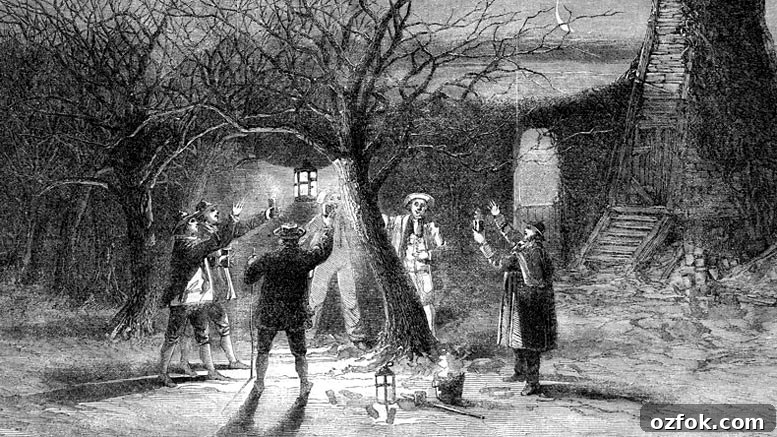
Traditional Wassailing In An Orchard (Apple Howling)
Wassailing is an age-old ritual of blessing the land around a home, farm or orchard. Its earliest forms trace back to pagan practices intended to wake the land from winter’s dormancy and encourage a fertile growing season. Historically, wassailing was especially focused on apple and pear trees, with the aim of ensuring a bountiful harvest. The tradition is most commonly observed around Twelfth Night—often the evening of January 5th or, in areas following the old calendar, January 17th—though local customs vary throughout mid-winter.
‘wassailing’ from the Oxford Dictionary of ‘English Folklore’
The entry describes two principal customs. The first is a house-visiting practice in which neighbours exchange good wishes and hospitality. The second is a field-visiting custom directed at crops and livestock, most commonly fruit trees. The proper day for wassailing differed by region but always fell in mid-winter, around Christmas or New Year. The name itself has many regional variants, including vessel-cup, waysailing, and howling.
In the house-visiting form, often led by young women, participants carried a bowl of drink—frequently spiced ale or cider—while wearing garlands and ribbons. That drink, commonly called lamb’s wool, combined hot ale or cider with roasted apples and spices. Traditional verses were sung as they moved door to door: “Wassail, wassail all over the town, Our toast is white, our ale is brown, Our bowl it is made of a maplin tree, We be good fellows all, I drink to thee.”
The field-visiting variant was typically male-led and focused on local orchards. Participants sang songs to the trees, beat trunks with sticks, splashed cider on the bark, and sometimes placed cider-soaked toast at the roots or in the branches to feed and encourage the trees. One common refrain went: “Here stands a good apple tree, stand fast root, Every little twig bear an apple big, Hats full, caps full, and three score sacks full, Hip! Hip! Hurrah!”
‘Gentleman’s Magazine’, Published May 1784
Historically, festive feasts included a large communal bowl that the master of the house drank from first, passing it around the table. It was also customary for poorer people at Christmas to go door-to-door with a decorated wassail cup—adorned with ribbons and sometimes a golden apple—singing and collecting funds to prepare lamb’s wool for their own celebrations.
Wassailing has persisted through the centuries and remains particularly associated with cider and perry regions of the UK, such as Somerset and Gloucestershire. While cider-based recipes are widespread today, ale-based versions of the wassail drink are believed to be older.
Lambswool, or Lamb’s Wool, is a traditional wassail drink named either for its pale, frothy appearance or from a historic phrase related to the Day of the Apple Fruit. Made from hot ale or cider with roasted apples and spices, lambswool was a central element of wassail gatherings. Samuel Johnson’s 1756 dictionary defined wassail as “a liquor made of apples, sugar, and ale; a drunken bout; a merry song.”
The word wassail comes from the Old English phrase wæs (þu) hæl, meaning “be healthy” or “be whole,” a meaning preserved in the modern expression “hale and hearty.” The earliest recorded reference to wassailing dates from the late 15th century, with payments noted for New Year wassails at St Mary De Pre Priory in St Albans.
WASSAILING – The Practice
On Twelfth Night (either the modern date of January 5th or the old date of January 17th), prepare a communal bowl by placing a thick slice of toasted rustic bread in the bottom and pouring in warm lambswool. Take the bowl outside to the garden, field or orchard with friends and family, carrying lighted torches and making a joyful racket with pots, pans and sticks. Hang more pieces of toast in the tree branches and bring extra cups of lambswool for drinking and splashing.
The ritual uses light and noise—calling out “wassail! wassail!” and singing traditional rhymes—to drive away lingering spirits of the old year and to encourage the tree’s vitality. Participants may beat the trunks lightly with sticks and splash a little lambswool on the bark. After everyone has drunk from the communal bowl, pour a small amount of the soggy toast and liquid around the roots of a tree, and place fresh pieces of lambswool-dipped toast in the branches as an offering to the coming season.
When wassailing apple trees, people often sing verses such as: “Apple tree, apple tree, we all come to wassail thee, Bear this year and next year to bloom and to blow, Hat fulls, cap fulls, three cornered sack fills, Hip, Hip, Hip, hurrah.” Or they may sing: “Here stands a good apple tree, stand fast root, Every little twig bear an apple big, Hats full, caps full, and three score sacks full, Hip! Hip! Hurrah!”
From ‘The Mirror Of Literature, Amusement And Instruction: Vol 1’, Published 1823
Origin Of The Wassail Bowl
New Year celebrations once included the wassail, when young women carried a bowl of spiced ale and sang verses while visiting homes. The term “wassail” derives from the Anglo-Saxon phrase meaning “be in health.” Historical accounts link the wassail-bowl to similar communal drinking customs in monasteries and universities, where the bowl sometimes held ceremonial significance and was known by titles such as Poculam Charitatis or the “Grace Cup.” A Gloucestershire wassailing song recorded in the early 19th century begins: “Wassail, wassail! all over the town, Our toast is white, our ale is brown; Our bowl is made of maplin tree, We be good fellows all—I drink to thee.”